


The International Organization for Standardization (ISO) has formally approved ISO/TS 23099, a new technical specification designed to assess and compare the environmental performance of large yachts over 30 metres in length. The project is inspired by the Yacht Environmental Transparency Index (YETI) developed by the Water Revolution Foundation.
Developed with contributions from leading yacht builders, naval architects, technical specialists, research institutes and classification societies, ISO/TS 23099 introduces a practical and robust methodology tailored specifically to the operational realities of the superyacht sector.
A yacht-specific environmental assessment framework
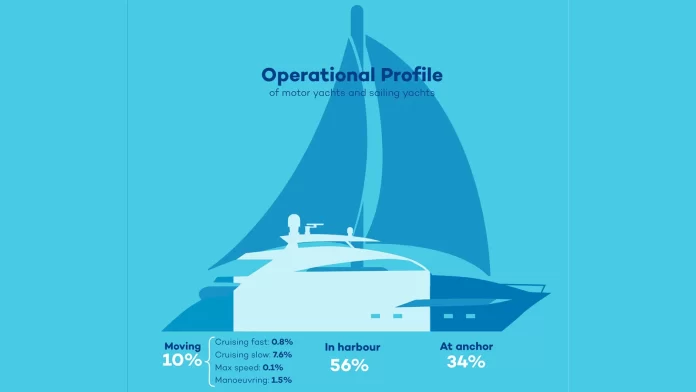
Unlike commercial shipping, large yachts follow a distinct operational profile. The new methodology benchmarks yachts using fixed median operational values statistically defined as 10% cruising, 34% at anchor and 56% in port. Performance is then expressed as a score plotted against a reference line of central tendency within different gross tonnage (GT) categories, enabling fair and meaningful comparisons across the fleet.
“The method benchmarks yachts through a fixed median operational profile that reflects how yachts are actually used,” explained Hanna Dąbrowska, Technical Director at the Water Revolution Foundation. “This approach provides a fundamentally different and more accurate framework than that applied to commercial shipping.”
A milestone for large yacht sustainability
ISO/TS 23099 is the first project delivered by ISO TC8 SC12 Working Group 6 (WG6) on Large Yachts Sustainability & Environment, operating under ISO Technical Committee 8 (TC8) and Subcommittee 12 (SC12) dedicated to large yachts.
“ISO is the way to unite cross-industry experts and proactively work together on standards where international legislation is absent or impractical,” said Robert van Tol, WG6 convenor. “There is now a yacht-specific method and an official reference that can be applied across the fleet.”
The Technical Specification has been approved by multiple National Standardization Bodies, including those representing major yacht-building nations such as Italy, the Netherlands, Germany, Turkey, Poland, the United Kingdom and the United States.
EcoPoints system enables transparency and improvement
By establishing a common framework and consistent assessment method, ISO/TS 23099 enables objective environmental comparison and supports informed decision-making for both new builds and refit projects. Results are expressed through an EcoPoints system, creating a shared language for environmental performance across the industry.
According to Awwal Idris, Environmental Expert at the Water Revolution Foundation, the assessment combines multiple environmental indicators, including CO₂ and NOx emissions. “This outcome enables users to fully understand environmental impact and evaluate alternative scenarios to drive improvement,” he noted.
A step toward measurable environmental responsibility
The approval of ISO/TS 23099 underscores the superyacht industry’s growing commitment to measurable, transparent and credible environmental responsibility.
“This and future projects under WG6 provide shipyards and industry stakeholders with practical tools to support environmentally driven yacht design, construction and operation,” concluded Lorenzo Pollicardo, Technical & Environmental Director at the Superyacht Builders Association (SYBAss).









 has formally approved ISO/TS 23099, a new technical specification designed to assess and compare the environmental performance of large yachts over 30 metres in length)