

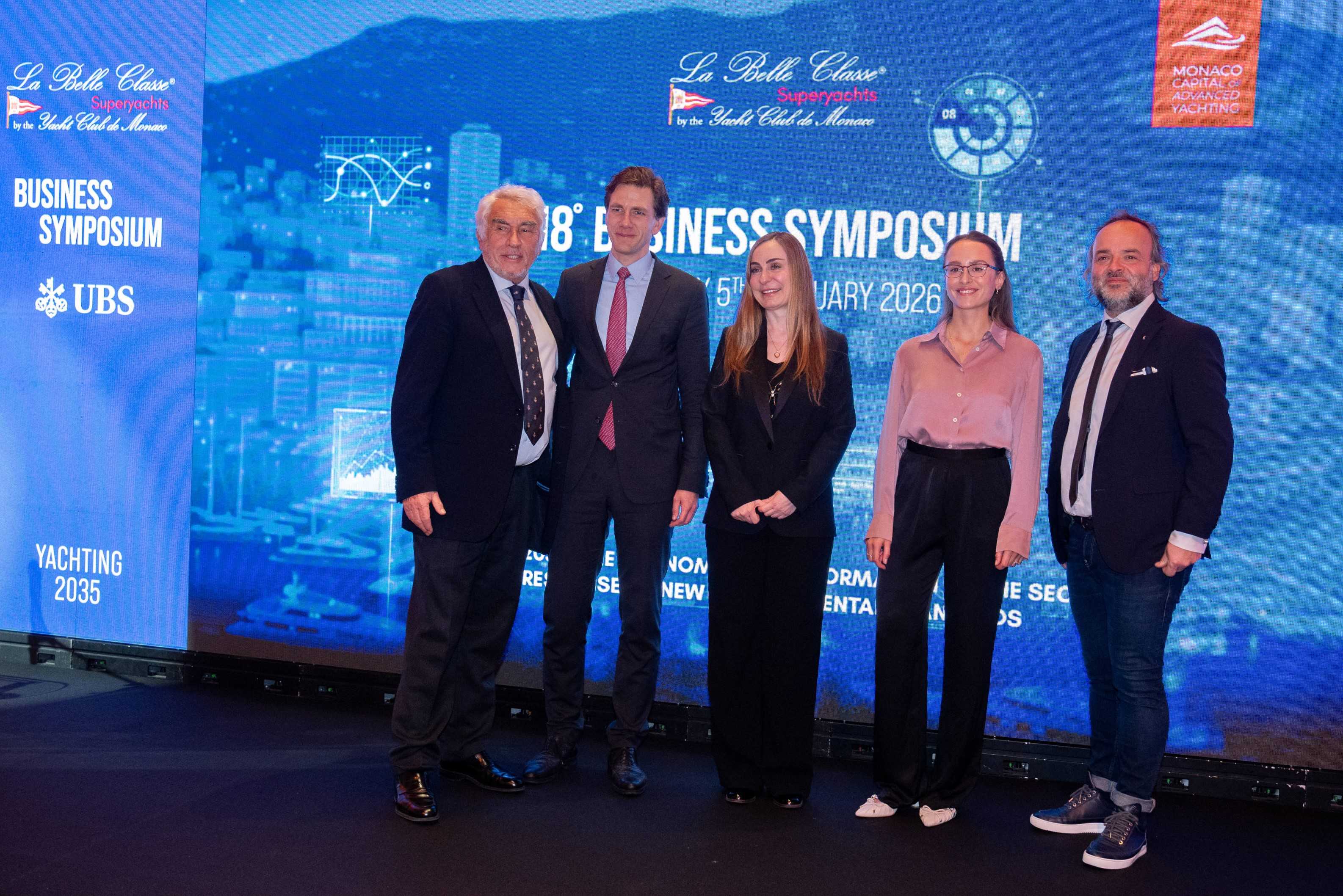
Held under the Monaco, Capital of Advanced Yachting initiative, the dinner debate reached a clear conclusion: the environmental transition is now a central driver of the yachting industry’s economic models.

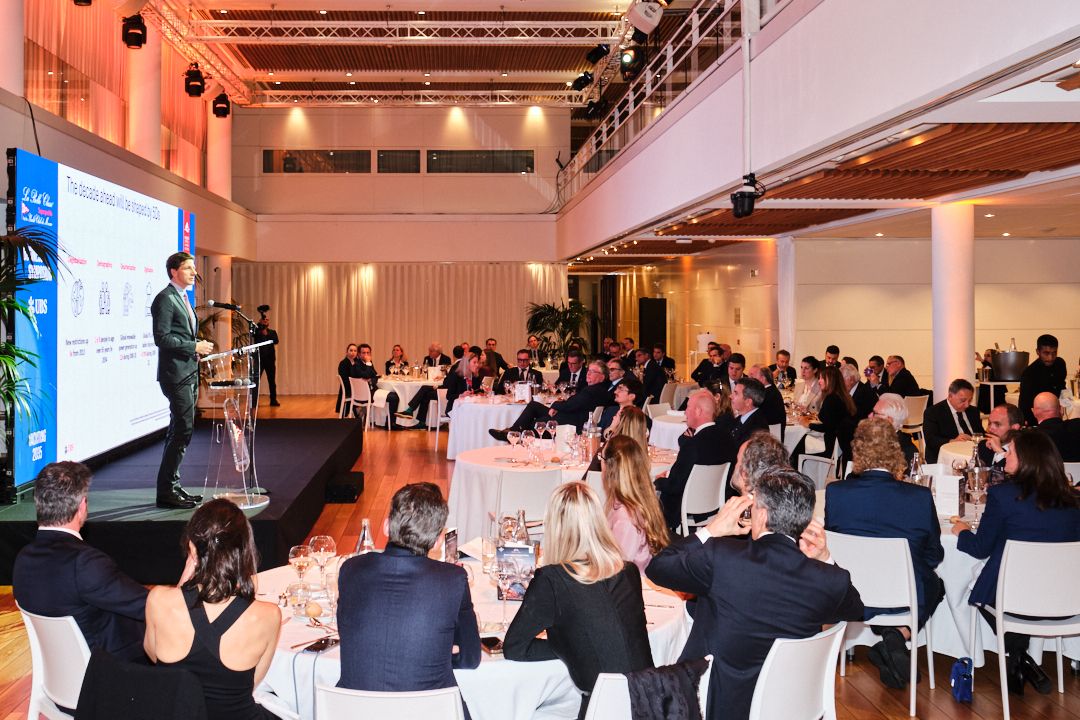
Under the theme “Yachting 2035: The economic transformation of the sector in response to new environmental standards”, the symposium offered forward-looking insights into the structural changes already underway. Against a backdrop of accelerating demographic, geopolitical, technological and financial shifts, discussions highlighted the urgency for the sector to anticipate long-term transformations that are no longer theoretical, but actively shaping decision-making today.
A sector at a strategic turning point
With a global economic impact estimated at €54 billion, nearly 80% concentrated in Europe, the yachting industry stands at a pivotal moment. The challenge ahead is to preserve value creation while integrating increasingly stringent environmental requirements.
“Yachting is part of an economic, environmental and human ecosystem that requires a collective, long-term vision. With close to one hundred participants, this symposium is a unique platform where all stakeholders across the yachting value chain can come together, exchange ideas, and collectively drive the sector forward,” said Bernard d’Alessandri, Managing Director and Secretary General of the Yacht Club de Monaco.
Echoing this perspective, Christophe Madrolle, Regional Councillor of Provence-Alpes-Côte d’Azur (Région Sud) and member of the Standing Committee and the Biodiversity, Sea, Coastline, Regional Natural Parks and Risk Commission, added:
“Environmental standards and sustainability challenges allow us to develop new strategies that enable economic growth while protecting the environment for future generations. We may go faster alone, but together we can go further.”
A data-driven view of a market in transformation
Opening the discussions, Francesca Webster, Editor-in-Chief of SuperYacht Times, presented a data-based overview of a sector that continues to grow despite deep structural changes. Today, more than 6,200 yachts over 30 metres are in operation worldwide, supported by a consistently strong order book—evidence of the superyacht market’s underlying resilience.
After a hesitant first half of 2025, marked by economic and political uncertainty, activity gradually recovered. “By the end of the year, transaction volumes exceeded those of 2024, with total sales and gross tonnage significantly higher than in previous years,” she explained.
Growth is increasingly concentrated in the over-80-metre segment, alongside a notable shift in the balance between new builds, brokerage and refit activity. The refit market alone represents an estimated €5.6 billion economic impact, with 71% generated by indirect activities such as suppliers, logistics, accommodation and services—delivering substantial benefits to local economies.
Qualitatively, the industry is evolving beyond pure volume. Project timelines are lengthening, technical complexity is increasing, and environmental performance is now embedded at the earliest design stages. “Owners are becoming increasingly aware. As legislation tightens, sustainability is becoming a decisive factor in vessel value,” Webster noted.
Macroeconomic forces reshaping yachting
Providing a global macroeconomic and geopolitical perspective, Maximilian Kunkel, Chief Investment Officer at UBS, framed his analysis around five long-term forces: demographics, deglobalisation, decarbonisation, digitalisation and debt.
Ageing populations are intensifying labour shortages and accelerating investment in automation and productivity-enhancing technologies. Deglobalisation is creating a multipolar world where geopolitical rivalry coexists with continued economic interdependence.
Meanwhile, decarbonisation and digitalisation are redefining production, consumption and working models, while historically high levels of public and private debt are reshaping the financial landscape. “Everything is changing: how we work, where we work, what we do and how we consume,” Kunkel observed. Despite these pressures, he remained cautiously optimistic: “Economic growth remains possible, provided we fully account for the interaction of these five dynamics.”
2035 standards: From regulation to economic reality
The regulatory horizon of 2035, once perceived as distant, is now firmly integrated into present-day strategy. Dr Nathalie Hilmi, expert in macroeconomics, international finance and sustainable development, underlined that environmental performance has become a fully-fledged economic indicator.
“Environmental regulation is no longer a future concern. Emissions are no longer an external cost; they are becoming a financial liability that directly impacts operating margins,” she explained.
While compliance requires significant investment—ranging from alternative fuels and new technologies to extensive refits—it also opens the door to new markets and competitive advantages. With new build activity alone generating around €20 billion, adapting to environmental standards represents a strategic challenge that goes far beyond regulatory compliance.
“Yachting in 2035 will be shaped as much by how we upgrade the existing fleet as by what we build next,” said Txema Rubio, Commercial Director of MB92 Group. “Investing in environmental upgrades through refit protects long-term value while meeting rising owner expectations.”
From added cost to value creation
Rather than a constraint, sustainability was widely viewed as a catalyst for innovation. Marnix Hoekstra, Co-Creative Director and Partner at Vripack, described the environmental transition as “the greatest design challenge of our generation.”
He highlighted Project Zero, a zero-emissions monohull powered by thermal, solar and wind energy, with 5MWh energy storage. Using cogeneration principles, the system recovers heat from photovoltaic panels for climate control. “Everything that needs heat comes from our thermal system. Everything that needs electricity comes from our batteries,” he explained.
Conceived as a vision rather than a regulatory response, the project reflects the expectations of a new generation of owners for whom sustainability is integral to both experience and value.
A collective vision led by the Yacht Club de Monaco
Through the Economic Symposium – La Belle Classe Superyachts, the Yacht Club de Monaco reinforces its role as a leading platform for dialogue and collaboration, shaping a yachting industry that is innovative, responsible and economically sustainable. This momentum continues during the Monaco Capital of Advanced Yachting Rendezvous (21–24 March), opening with a careers fair dedicated to the next generation.


Key Figures (Source: SuperYacht Times)
- €54 billion – Global economic impact of the superyacht industry
- €20 billion – Economic impact of new build activity
- €5.6 billion – Economic impact of the refit market
- €1.1 billion – Global economic impact of brokerage and charter
- 80% of global production concentrated in Europe (Italy, the Netherlands and Germany)



%20convened%20leading%20figures%20from%20across%20the%20international%20yachting%20industry%20to%20examine%20the%20profound%20economic%20shifts%20shaping%20the%20sector%E2%80%99s%20future.)